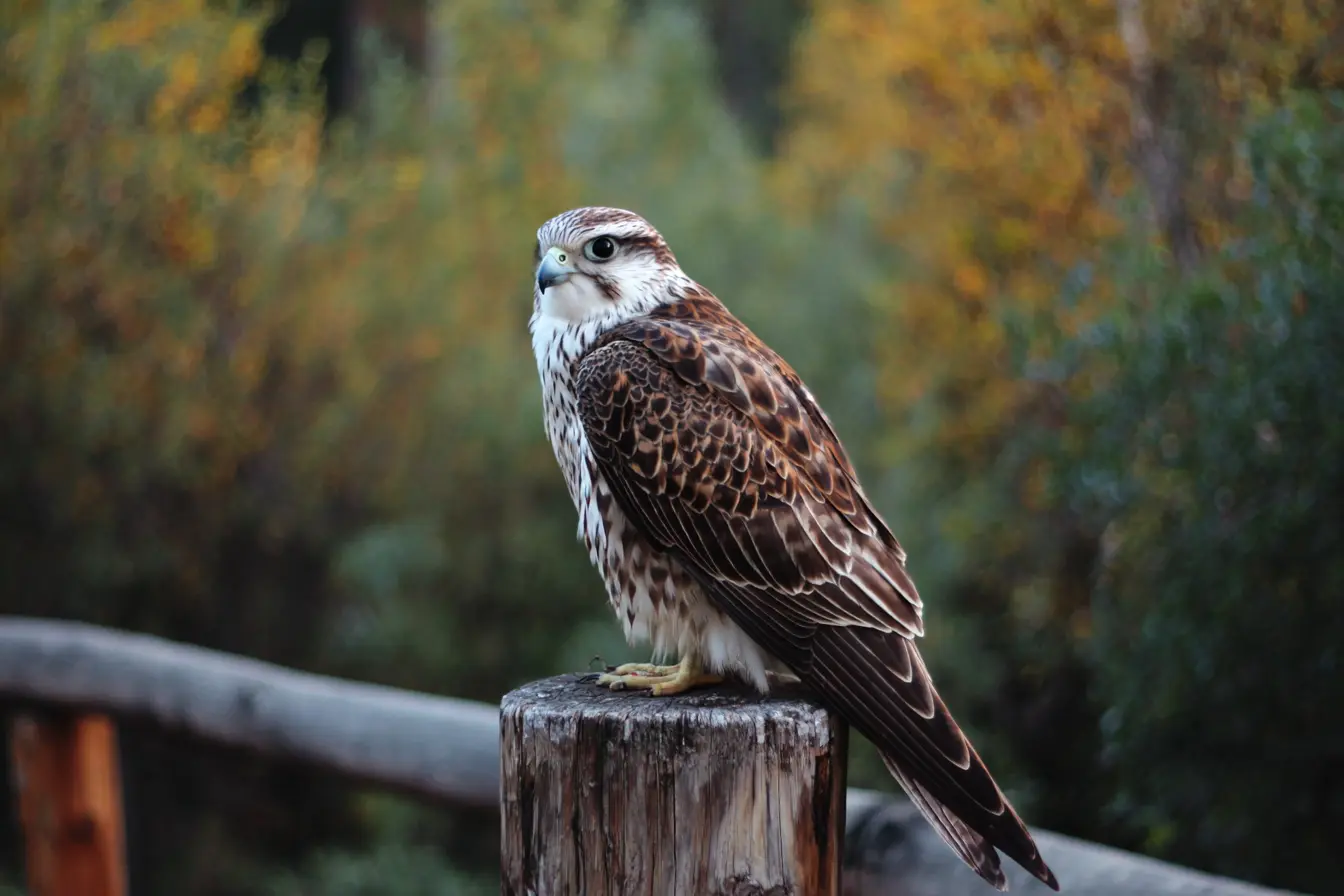
The Saker Falcon (Falco cherrug) is one of the largest and most powerful falcons used in falconry. Native to Eastern Europe, Central Asia, and the Middle East, the Saker is renowned for its strength, speed, and versatility as a hunting bird. Historically prized by nomadic falconers for its ability to take quarry such as hares and bustards, today it is kept by experienced falconers worldwide, including in the UK. Sakers are not beginner birds. They require extensive knowledge, handling skill, and dedication but for those prepared, they are an awe-inspiring falconry partner.
Appearance and Characteristics
Size: Large falcon; females (1,000–1,300g) are bigger and more powerful than males (750–1,000g).
Plumage: Varies from dark brown to sandy pale, often with streaked underparts. Lacks the bold moustache of the Peregrine Falcon.
Flight Style: Strong, direct flight with powerful stoops, though generally less acrobatic than a Peregrine. Better adapted to open ground hunting.
Temperament: Intelligent but more high-strung than some species; can be nervous or aggressive if not handled properly.
Legal Considerations in the UK
Wildlife and Countryside Act 1981: Sakers are non-native, but as a CITES-listed species, they require proof of legal captive breeding.
Schedule 4 Registration: All Saker Falcons in the UK must be registered with DEFRA.
CITES Appendix II: International trade requires permits, and captive-bred birds must have closed rings or microchips.
Hunting Permissions: You must have landowner consent to hunt with a Saker Falcon.
Housing Requirements
Mews (Aviary)
Size: Minimum 3m × 3m × 2.5m; larger is better for flight conditioning.
Design: Sheltered, weatherproof space with plenty of natural light and ventilation.
Perches: Block perches are most common for falcons; provide multiple options to reduce stress and prevent foot problems.
Safety: Escape-proof and predator-proof, with double-door entry systems.
Weathering Area
A secure outdoor section for tethering in good weather, allowing sunlight and fresh air.
Shade should always be available to prevent overheating.
Equipment Needed
Gauntlet: Heavy leather glove for safe handling.
Anklets, Jesses, and Leash: Standard falconry equipment for tethering and control.
Swivels: To prevent twisting of the leash.
Hood: Essential for calming the falcon during handling and transport.
Telemetry: GPS or radio tracker is absolutely essential; Sakers are powerful and can fly far quickly.
Weighing Scales: Accurate to 1g for daily weight monitoring.
Diet and Feeding
Typical Diet
Pigeon
Quail
Partridge
Rabbit (cut into manageable portions)
Day-old chicks (as part of a varied diet, not exclusively)
Feeding Guidelines
Offer a variety of prey types for balanced nutrition.
Always feed whole prey (including bones, feathers, or fur) for digestive and nutritional health.
Provide clean water for drinking and bathing daily.
Training a Saker Falcon
Manning
The process of taming and accustoming the bird to human presence.
Sakers may be nervous initially and require consistent, calm handling.
Creance Training
Early recall training on a long line to establish trust and obedience.
Helps the bird develop muscle strength before free flight.
Lure Training
A cornerstone of falcon training, especially for Sakers.
Use a lure to simulate prey and reinforce recall, fitness, and hunting technique.
Free Flight
Only attempted once recall is reliable.
Sakers are best flown in large, open areas where they can use their speed and power.
Hunting with a Saker Falcon
Quarry: Rabbits, hares, pheasants, partridges, and corvids.
Style: Sakers hunt with explosive chases, either from a perch or after being slipped from the fist.
Conditions: Best suited to open farmland, heathland, or moorland where visibility is clear.
Health and Maintenance
Common Health Issues
Aspergillosis: A fungal respiratory disease common in large falcons kept in damp or poorly ventilated housing.
Bumblefoot: A foot infection caused by poor perching surfaces or hygiene.
Stress Injuries: Powerful bate-offs (flying off the glove in panic) can cause feather or leg damage.
Preventative Care
Keep housing dry, clean, and well-ventilated.
Rotate perch types to maintain foot health.
Weigh daily to monitor condition.
Use an avian vet familiar with falcons.
Daily Responsibilities
Feeding fresh prey daily.
Flying regularly to maintain fitness and mental stimulation.
Weighing before every flight to ensure correct flying weight.
Inspecting feathers, equipment, and body condition.
Suitability for Falconers
Not for Beginners: Sakers are powerful, high-maintenance falcons requiring prior experience with smaller species like Harris’s Hawks or Peregrines.
Best for Open Country: They thrive in wide, open landscapes rather than confined areas.
High Commitment: Require daily flying, careful diet management, and precise handling.
Lifespan and Commitment
Saker Falcons can live 15–20 years in captivity, sometimes longer with excellent care. Keeping one is a long-term responsibility involving:
Daily handling and exercise
Ongoing costs for housing, food, and vet care
Advanced falconry skills and continuous learning
Conclusion
The Saker Falcon is a magnificent raptor that embodies power, elegance, and tradition in falconry. While not suitable for beginners, experienced falconers who can meet their demanding needs will find them to be loyal, impressive, and highly capable hunting partners. With the right training, housing, diet, and respect, a Saker Falcon can offer decades of breathtaking flights and a partnership that honours one of falconry’s most storied birds.
Quick questions
- What should I know about saker falcon?
- The Saker Falcon is a large bird native to Eastern Europe, Central Asia, and the Middle East, known for its power and speed in falconry. It is not suitable for beginners and requires experienced handlers. Vet Verified can help you compare UK veterinary practices by location, species, services and opening hours before you call.
- When should I contact a vet about saker falcon?
- Contact a veterinary practice if your pet seems unwell, symptoms are getting worse, you are unsure what to do, or the situation may be urgent. Vet Verified helps you compare practice details, but a vet should advise on your pet's current care.
- Can Vet Verified help me find bird vets?
- Yes. Use Vet Verified to compare bird vets across the UK, then check practice profiles and call directly to confirm current availability.
Find a vet
Find a veterinary practice
Compare UK veterinary practices related to this topic. Call the practice to confirm its current services and availability.