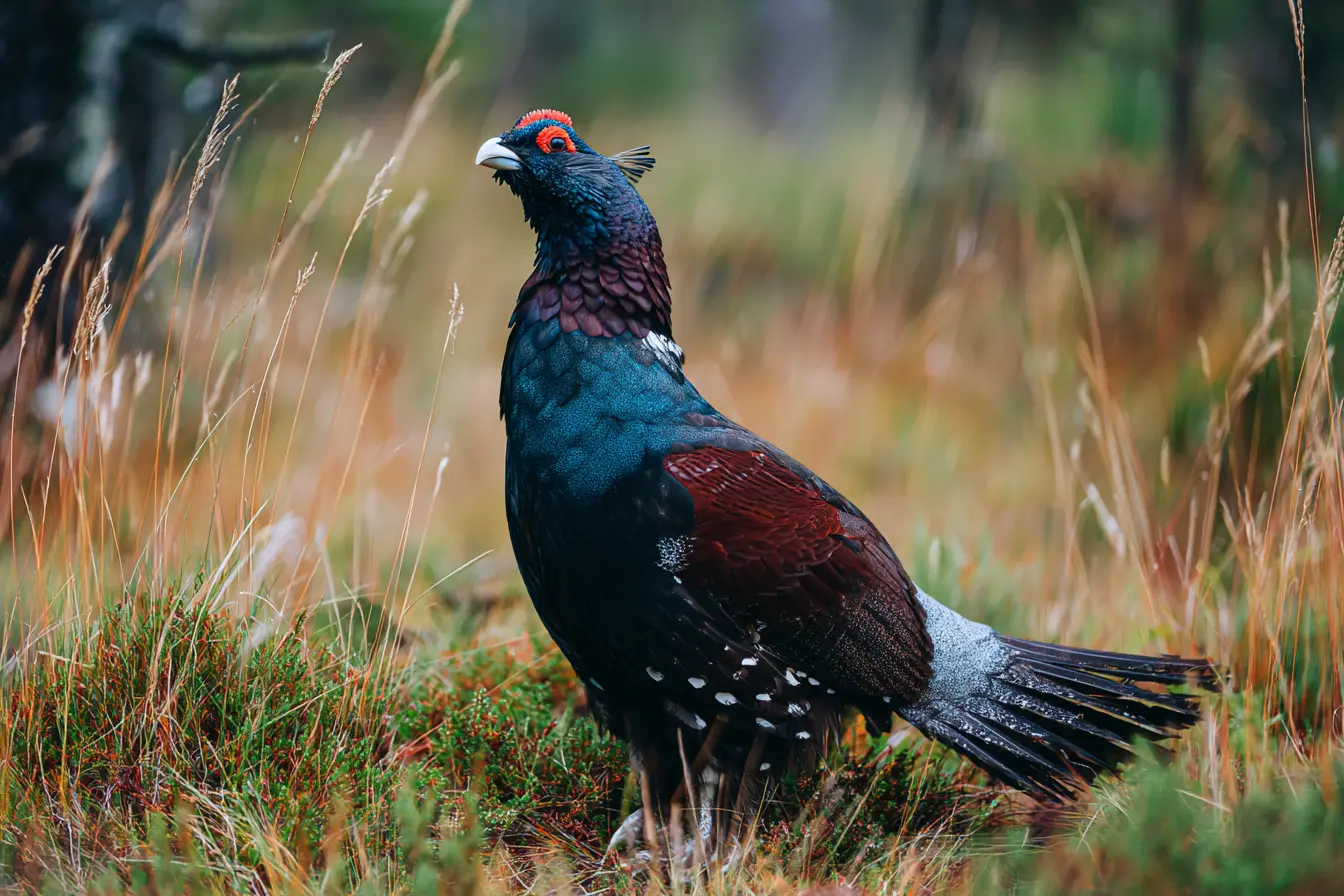
The Capercaillie, one of Britain’s most impressive and rarest birds, is a symbol of the Scottish Highlands and an icon of woodland conservation. With their striking size, elaborate mating displays, and deep connection to Caledonian pine forests, Capercaillie are both fascinating and highly protected. Keeping or managing these magnificent birds is an exceptional responsibility that requires strict legal compliance, deep ecological understanding, and absolute commitment to conservation.
This guide explores everything you need to know about the Capercaillie — its natural history, legal protections, habitat requirements, conservation management, and the grants and incentives available to landowners to help improve and protect its habitat in the United Kingdom.
Understanding the Capercaillie
The Capercaillie (Tetrao urogallus) is the largest member of the grouse family. Males, known as cocks, can weigh up to 4 kilograms and have a wingspan exceeding one metre. They are famous for their dramatic spring courtship displays, called leks, during which males fan their tails, raise their beaks, and emit a sequence of clicking and popping calls to attract females.
Key Characteristics
Males have glossy black plumage with green and blue iridescence, red wattles, and a white shoulder patch.
Females are smaller, brown, and barred, providing natural camouflage.
They are primarily ground-dwelling but strong fliers when disturbed.
The name “Capercaillie” comes from the Gaelic “capull coille”, meaning “horse of the woods”, reflecting their size and strength.
Conservation Status
The Capercaillie is one of the most endangered birds in the UK. Once extinct by the late 1700s, it was successfully reintroduced to Scotland in the 19th century, but populations have declined sharply again, with fewer than 600 individuals now thought to survive.
The main causes of decline include:
Habitat loss and fragmentation
Collisions with deer fencing
Disturbance during breeding
Predation of eggs and chicks
Climate change reducing insect food availability
Conservation now focuses on habitat restoration, reducing human disturbance, and protecting the remaining populations within the Cairngorms and other parts of northern Scotland.
Legal Protection
Capercaillie are afforded the highest level of protection under UK and Scottish law. It is illegal to kill, capture, disturb, or keep them without special authorisation.
Key Legislation
Wildlife and Countryside Act 1981 (Schedule 1) – Protects Capercaillie and their eggs and nests.
Nature Conservation (Scotland) Act 2004 – Reinforces obligations to conserve biodiversity and protect habitats.
EU Birds Directive (Annex I) – Retained in UK law, requiring strict protection and habitat conservation.
Anyone wishing to keep, breed, or rehabilitate Capercaillie must obtain a licence from NatureScot or the Animal and Plant Health Agency (APHA). Licences are issued only for scientific, conservation, or educational purposes.
Habitat Requirements
Capercaillie rely on Scots pine and birch woodlands with a healthy understorey of blaeberry (bilberry) and other berry plants. The best habitats combine shelter, feeding areas, and low disturbance.
Ideal Habitat Features
Mixed-age pine and birch stands with open canopy structure.
Rich field layer vegetation, including blaeberry and crowberry.
Damp areas that support insect-rich environments for chicks.
Low human disturbance, especially around lekking and nesting sites.
Conservation management often includes removing non-native conifers, restoring natural forest structure, and reducing fencing hazards.
Feeding and Nutrition
Capercaillie feed on a variety of natural foods depending on the season:
Spring and summer – Shoots, buds, herbs, and insects (vital for chicks).
Autumn – Berries, seeds, and leaves.
Winter – Pine needles and shoots when other food is scarce.
In captive conservation settings, birds are offered heather, berries, green leaves, and specialist game bird feed, often supplemented with Scots pine branches to replicate their natural diet.
Breeding and Life Cycle
Breeding takes place between April and May. Males display at leks, often returning to the same site each year. A dominant male may mate with several females.
Nesting and Rearing
Nests are ground scrapes lined with heather and grass.
Females lay 6–10 eggs and incubate them for about 26 days.
Chicks leave the nest soon after hatching and feed mainly on insects.
The mother alone raises and protects the brood.
In licensed conservation facilities, eggs may be artificially incubated, and chicks reared for release into the wild. This process requires expert supervision, genetic management, and strict welfare standards.
Health and Welfare
Capercaillie are hardy in the wild but vulnerable in captivity to stress and disease. Preventative care includes:
Regular veterinary oversight and parasite monitoring.
Clean, well-ventilated enclosures.
Minimising disturbance and noise.
Access to natural vegetation and enrichment materials.
Grants and Incentives for Landowners
There are several financial incentives and grant programmes available to support landowners and managers in improving and maintaining Capercaillie habitats, especially in Scotland.
1. Capercaillie Habitat Grant Scheme (Cairngorms National Park)
A dedicated Capercaillie Habitat Grant Scheme operates within the Cairngorms National Park to help landowners carry out practical habitat improvements.
Grants of up to £5,000 are available to support works that benefit Capercaillie and their habitat.
Eligible activities include:
Removing non-native trees to promote native Scots pine and birch.
Blocking drains to restore boggy ground.
Bracken and invasive species control.
Fence marking or removal to prevent collisions.
Predator management and creation of grit piles.
Reducing disturbance near lek sites.
Grants can cover machinery, contractor costs, and materials.
Applications are typically open for a short window each spring (for example, March to May).
More information: Cairngorms Capercaillie Project
2. Forestry Grant Scheme (FGS) – Habitat and Predator Control Options
The Forestry Grant Scheme (FGS), administered by the Scottish Government, provides funding for habitat management under the Woodland Improvement Grant – Habitats & Species option.
Predator control within 1.5 km of an active lek site is supported at £6.60 per hectare per year for up to five years.
Eligible actions include:
Thinning woodland to improve understorey vegetation.
Removing deer fences or marking existing ones.
Managing predators around nesting and display areas.
Applicants must hold a forest or management plan and meet the UK Forestry Standard.
Details available from: Rural Payments and Services
3. Wildlife and Conservation Funds
Other organisations also provide funding for Capercaillie-related conservation projects.
BASC Wildlife Fund – Offers grants for habitat restoration, fence marking, and species protection. For example, £52,405 was awarded in 2023 to support Capercaillie restoration in Badenoch and Strathspey.
Private Trusts and NGOs – Bodies such as the RSPB, Scottish Environment LINK, and Cairngorms Connect occasionally fund collaborative habitat projects.
4. Key Benefits for Landowners
Enhances woodland biodiversity and improves wider ecosystem health.
Supports legally compliant and sustainable land management.
May increase property’s environmental value and conservation credentials.
Access to expert guidance from foresters, ecologists, and grant officers.
5. Considerations and Responsibilities
Land must usually fall within a recognised Capercaillie range (mainly the Cairngorms area).
Many grants require a long-term management commitment beyond the initial funding.
Some maintenance, such as ongoing fence marking and habitat monitoring, may remain the landowner’s responsibility.
Evidence of lek sites or Capercaillie presence may be needed for eligibility.
Conservation actions must comply with wildlife and welfare legislation.
These incentives are vital in maintaining and restoring native pinewoods that support not just Capercaillie but many other species of Scotland’s upland forests.
Conservation Projects and Partnerships
Major projects supporting Capercaillie recovery include:
Cairngorms Capercaillie Project – Works with local landowners and communities to reduce disturbance, restore habitat, and improve woodland connectivity.
NatureScot and RSPB Scotland – Lead initiatives for forest restoration and research.
Cairngorms Connect Partnership – Focused on long-term restoration of the Caledonian forest ecosystem.
Observation and Ethical Practices
Capercaillie are highly sensitive to disturbance. During the breeding season, particularly in spring, forest users should avoid lekking areas and follow marked trails. Licensed researchers and photographers must operate under strict conditions to avoid stress or nest abandonment.
Conclusion
The Capercaillie is a magnificent yet fragile symbol of Scotland’s natural heritage. Protecting it demands collaboration between conservationists, landowners, and local communities. For land managers within its range, a variety of grants and schemes now exist to help restore native pinewoods, manage predators, and reduce human disturbance, ensuring that these spectacular birds can continue to thrive.
By taking advantage of these opportunities and committing to long-term habitat stewardship, landowners can play a vital role in securing the future of one of Britain’s rarest and most remarkable birds.
Quick questions
- What should I know about capercaillie?
- The Capercaillie is a rare bird in the UK, mainly found in the Scottish Highlands. Known for its size and courtship displays, it needs special habitats with Scots pine and birch. Vet Verified can help you compare UK veterinary practices by location, species, services and opening hours before you call.
- When should I contact a vet about capercaillie?
- Contact a veterinary practice if your pet seems unwell, symptoms are getting worse, you are unsure what to do, or the situation may be urgent. Vet Verified helps you compare practice details, but a vet should advise on your pet's current care.
- Can Vet Verified help me find bird vets?
- Yes. Use Vet Verified to compare bird vets across the UK, then check practice profiles and call directly to confirm current availability.
Find a vet
Find a veterinary practice
Compare UK veterinary practices related to this topic. Call the practice to confirm its current services and availability.
Search by species
- Bird vets Find UK veterinary practices that list care for birds. Compare opening hours, services, facilities and verified profiles, then contact a practice directly.
- Horse vets Find UK veterinary practices that list care for horses or other equines. Compare services, facilities, contact details and verified profiles, then contact a practice directly.