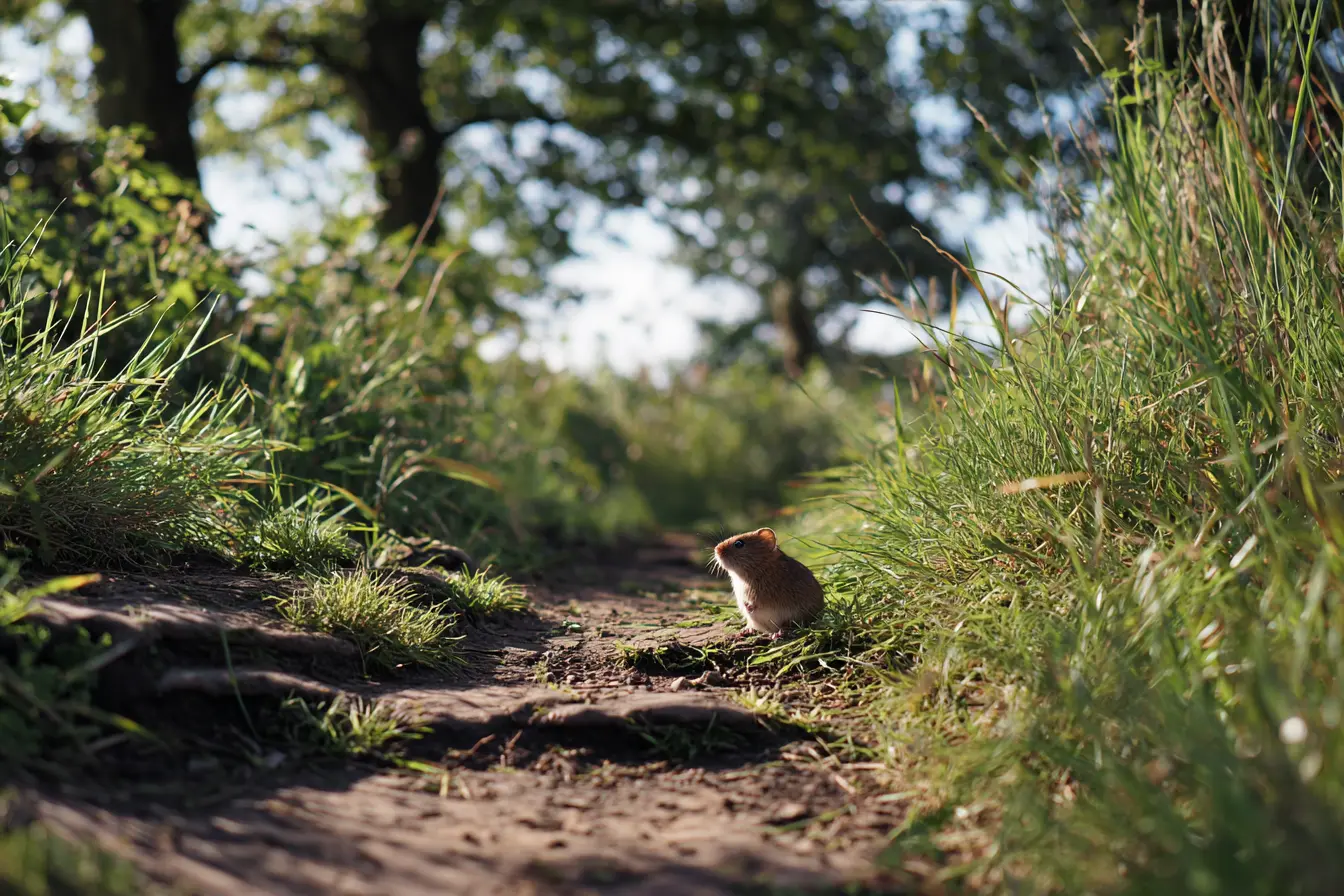
The field vole (Microtus agrestis) is one of the most abundant and ecologically important small mammals in the UK. Often unseen by humans, this secretive rodent plays a critical role in supporting numerous species of birds and mammals and helps to shape grassland ecosystems. Despite their small size, field voles are a cornerstone of the countryside food web.
This blog post explores the world of field voles, including their appearance, behaviour, habitat, diet, reproduction, threats, and their ecological importance in the British landscape.
Identification and Appearance
Field voles are compact, ground-dwelling rodents that are often confused with mice or bank voles. However, they have several distinctive features that set them apart.
Key features
Size: Body length 9–12 cm; tail around 3–5 cm.
Fur: Coarse brown or greyish fur on top, with lighter undersides.
Face: Blunt nose, small eyes and ears often hidden in the fur.
Tail: Shorter than a mouse’s and less than half the length of the body.
Movement: They scurry through grass rather than climb.
Their short tail and rounded features are good clues for identification, especially in contrast to the longer-tailed, more agile wood mouse.
Distribution and Habitat
Field voles are widespread across the UK, found from lowland meadows to upland moors.
Preferred habitats
Rough grassland
Field margins and hedgerows
Moorland and heath
Marshes and wet meadows
Woodland edges and glades
They avoid dense woodland and prefer areas with thick, tussocky grasses that provide cover and food.
Behaviour and Lifestyle
Field voles are largely solitary and live short but active lives. They create complex networks of runways beneath the grass, which they use to travel, feed, and evade predators.
Daily activity
Active throughout the day and night (crepuscular and nocturnal peaks).
Maintain and defend small territories.
Rarely stray far from cover.
Their grass tunnels are often visible after frost or snow, and their feeding stations are marked by nibbled grass and droppings.
Diet and Feeding
Field voles are herbivores, feeding mainly on the soft parts of plants.
Common food sources
Grasses (particularly the base and stem)
Sedges and rushes
Herbs and mosses
Occasionally bark or roots in winter
They may strip vegetation in patches, leaving characteristic signs of grazing at ground level.
Reproduction and Life Cycle
Field voles have a rapid and prolific breeding cycle, particularly in warmer months when food is abundant.
Breeding facts
Breeding season: March to October (can breed year-round in mild conditions).
Gestation: Around 21 days.
Litter size: 3–7 pups, with multiple litters per year.
Maturity: Young can breed from as early as 3–4 weeks old.
Lifespan: Typically less than 1 year in the wild.
Populations can fluctuate dramatically from year to year, especially in upland areas, where they are known for multi-year boom-and-bust cycles.
Predators and Threats
Field voles are a key prey species for many of the UK’s top predators.
Natural predators
Kestrels and short-eared owls
Foxes and stoats
Weasels and polecats
Adders and grass snakes
Buzzards and hen harriers
They are so numerous in some areas that predator breeding success can be directly tied to vole abundance.
Human-related threats
Habitat loss due to agricultural intensification
Pesticide and herbicide use affecting food and cover
Poorly managed grasslands with little structural diversity
Vole populations can recover quickly when conditions improve, making them resilient under the right circumstances.
Ecological Importance
Despite their modest appearance, field voles are ecological linchpins.
Roles in the ecosystem
Primary prey for many predators—supporting bird of prey populations like barn owls and kestrels.
Influence vegetation through grazing, contributing to plant community dynamics.
Their burrows and runways aerate soil and create microhabitats for invertebrates.
In short, they are a foundational species in many UK habitats, particularly in grassland and upland ecosystems.
Signs of Field Voles
You may not often see a field vole directly, but you can detect their presence through:
Winding surface runways through the grass
Small, round droppings (about 5 mm long)
Nibbled grass stems cut at a 45-degree angle
Small burrow entrances at the base of vegetation
These signs are particularly visible in winter or after mowing.
Conclusion
Field voles may be small, but they are giants of the ecosystem. As prolific breeders, constant grazers, and prey for numerous predators, their role in the UK countryside is hard to overstate. Encouraging grassland management practices that maintain rough, tussocky vegetation helps sustain healthy vole populations, which in turn supports a diverse range of wildlife.
Next time you walk through a wild meadow or across a heath, spare a thought for the bustling world beneath your feet, where field voles scurry through grass tunnels, quietly sustaining the natural balance of Britain’s wild places.
Quick questions
- What should I know about field vole?
- Field vole (Microtus agrestis) is a common small rodent in the UK and an important part of grassland life. It has a short tail, round face and coarse brown fur, and moves in runways through thick tussocky grass. Vet Verified can help you compare UK veterinary practices by location, species, services and opening hours before you call.
- When should I contact a vet about field vole?
- Contact a veterinary practice if your pet seems unwell, symptoms are getting worse, you are unsure what to do, or the situation may be urgent. Vet Verified helps you compare practice details, but a vet should advise on your pet's current care.
- Can Vet Verified help me find bird vets?
- Yes. Use Vet Verified to compare bird vets across the UK, then check practice profiles and call directly to confirm current availability.
Find a vet
Find a veterinary practice
Compare UK veterinary practices related to this topic. Call the practice to confirm its current services and availability.