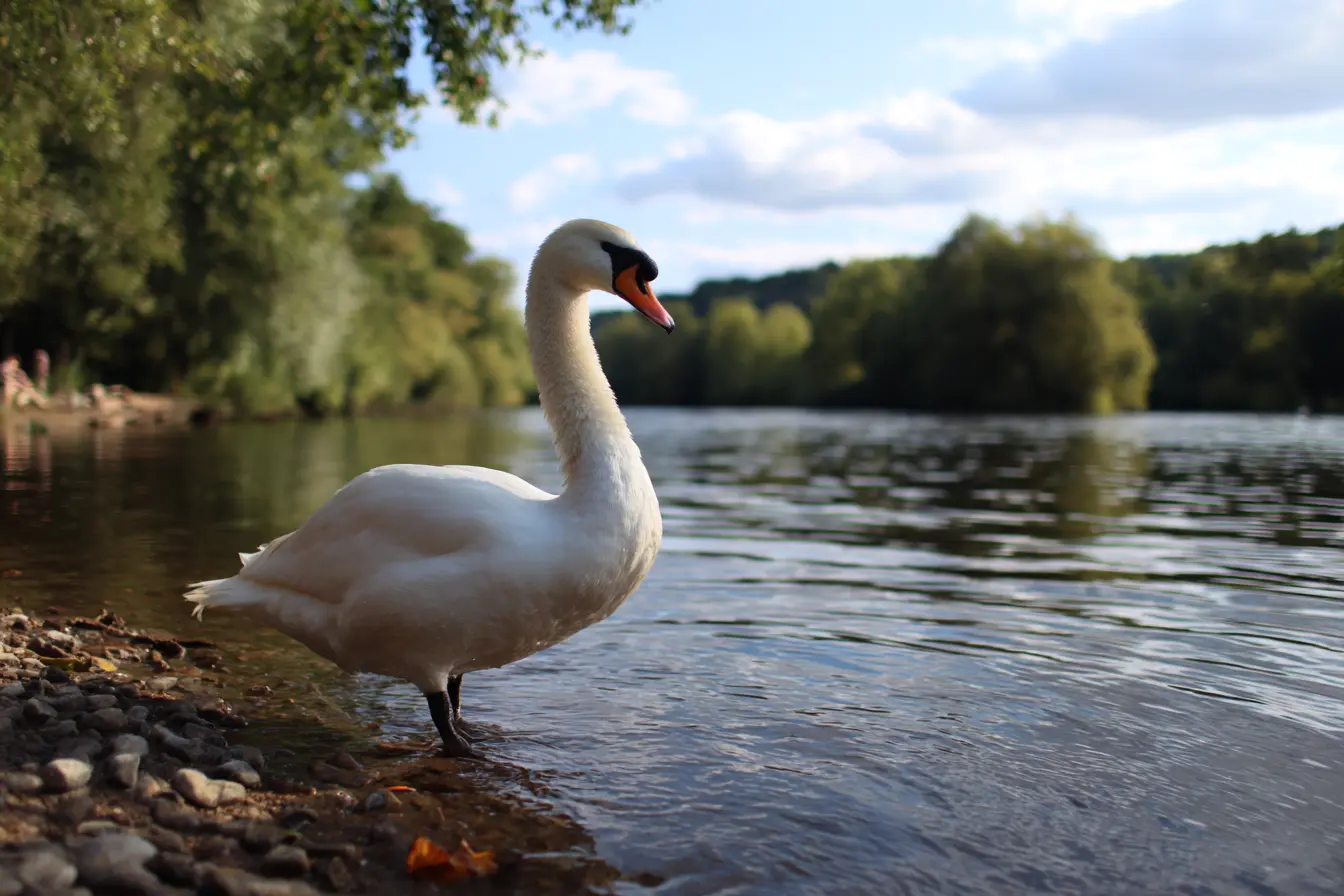
Swans are among the most recognisable and admired birds in the UK. Their size, elegance and powerful flight make them a striking presence on lakes, rivers and wetlands. While many people assume there is only one type of swan, the UK is home to three regularly occurring wild species, one resident and two winter visitors.
Learning to distinguish them adds an extra layer of enjoyment to any walk near water.
Mute Swan
The mute swan is the most familiar swan in the UK and the only species that breeds widely here.
It is large and entirely white, with:
A bright orange bill
A prominent black knob at the base of the bill
A long, gracefully curved neck
Black facial markings around the bill
Despite the name, mute swans are not silent. They can hiss, grunt and make snorting sounds, particularly when defending territory. The name refers to their lack of loud, trumpet-like calls compared to other swan species.
Mute swans are resident year-round and are commonly seen on:
Rivers
Lakes
Canals
Park ponds
Estuaries
During breeding season, they are territorial and may aggressively defend their nest or cygnets.
Whooper Swan
The whooper swan is a winter visitor to the UK, arriving from Iceland and northern Europe in autumn.
It closely resembles the mute swan but can be distinguished by:
A yellow and black bill (with a large yellow patch extending to the nostrils)
No black knob at the base of the bill
A straighter neck posture
A loud, trumpeting call
Whooper swans are slightly smaller than mute swans and often hold their necks upright rather than curved.
They are typically found in:
Large lakes
Wetlands
Flooded fields
Estuaries
Large flocks can be seen in parts of Scotland, northern England and eastern England during winter.
Bewick’s Swan
Bewick’s swan is the smallest of the three UK swan species and, like the whooper, is a winter visitor.
They breed in Arctic Russia and migrate to the UK for the winter months.
Bewick’s swans can be identified by:
A yellow and black bill (with a smaller yellow patch than the whooper)
No knob at the base of the bill
Smaller overall size
Shorter neck
The pattern of yellow on each bird’s bill is unique, much like a fingerprint.
Bewick’s swans are often found on:
Wetland reserves
Shallow lakes
Flooded farmland
Their numbers in the UK have declined in recent years, making sightings increasingly significant.
How to Tell Them Apart at a Glance
If you are unsure which swan you are looking at, focus on the bill:
Orange bill with black knob — Mute swan
Yellow and black bill, no knob, large yellow patch — Whooper swan
Yellow and black bill, no knob, smaller yellow patch, smaller bird — Bewick’s swan
Listening can also help. Whooper and Bewick’s swans are much more vocal than mute swans.
Resident vs Winter Visitors
In summary:
Mute swans live in the UK year-round and breed widely.
Whooper swans visit in winter from Iceland and northern Europe.
Bewick’s swans visit in winter from Arctic Russia.
Winter is the best time to see all three species together, particularly at major wetland reserves.
Where to See Wild Swans in the UK
You are most likely to encounter swans in:
Nature reserves managed by organisations such as the RSPB or WWT
Large reservoirs
Flooded fields in winter
Coastal estuaries
Slow-moving rivers
Some reserves are particularly well known for wintering swans, especially in eastern and northern regions.
Swans and the Law
All wild swans in the UK are protected under the Wildlife and Countryside Act 1981. It is illegal to harm them or interfere with their nests.
Mute swans also have historic legal protections, although in modern practice they are treated as protected wild birds like other native species.
Conclusion
The UK’s swans offer a blend of year-round familiarity and seasonal spectacle. The graceful mute swan is a constant presence on waterways, while the arrival of whooper and Bewick’s swans each autumn signals the changing of the seasons.
By paying close attention to bill colour, size and behaviour, you can confidently identify each species. Whether seen gliding silently across a lake or flying overhead in a calling flock, swans remain one of the most captivating sights in British wildlife.
Quick questions
- What should I know about uk swan identification?
- A simple guide to UK swans: mute swan, whooper swan and Bewick's swan. Learn to identify swans by bill colour and shape. Mute swans are large, white, have an orange bill with a black knob and a curved neck. Vet Verified can help you compare UK veterinary practices by location, species, services and opening hours before you call.
- When should I contact a vet about uk swan identification?
- Contact a veterinary practice if your pet seems unwell, symptoms are getting worse, you are unsure what to do, or the situation may be urgent. Vet Verified helps you compare practice details, but a vet should advise on your pet's current care.
- Can Vet Verified help me find bird vets?
- Yes. Use Vet Verified to compare bird vets across the UK, then check practice profiles and call directly to confirm current availability.
Find a vet
Find a veterinary practice
Compare UK veterinary practices related to this topic. Call the practice to confirm its current services and availability.