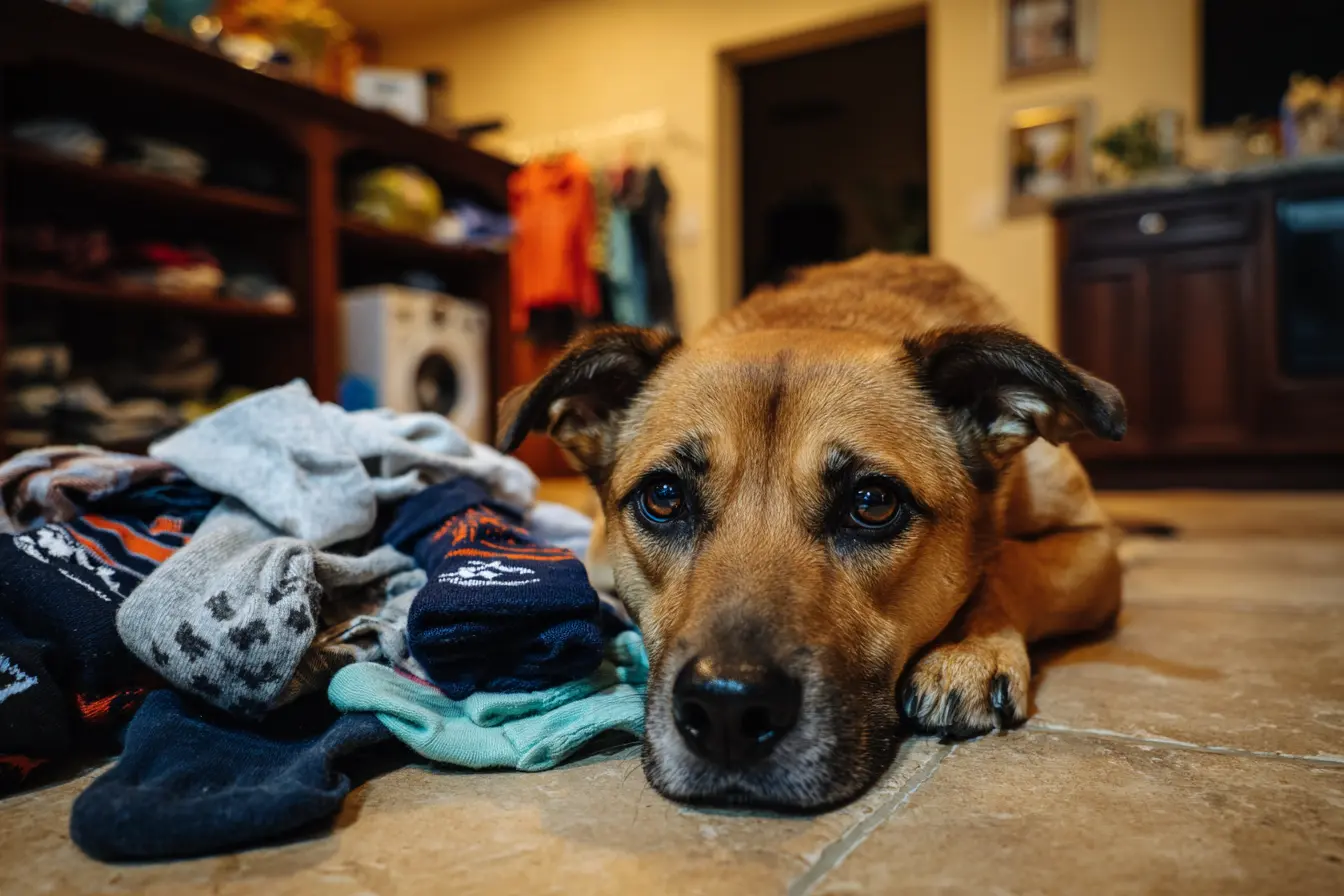
If you've just seen your dog gulp down a sock, or you've found a chewed toy with a piece missing, phone your vet now. Don't wait to see whether a problem develops, even if your dog is acting completely normally.
What counts as a foreign body
Vets call a non-digestible object that a dog swallows a foreign body. If it is too large to move on from the stomach or small intestine, it becomes lodged, and food and waste can't pass through the gut normally. Gut obstructions are emergencies that often require surgical removal.
Common culprits include toys, socks or other clothing, rocks and corn cobs. PDSA's vets also mention underwear, dummies and bouncy balls.
A very large, sharp or spiky item may tear the gut, and string and ribbon, which vets call linear foreign bodies, can cause more severe damage too. When the gut is torn, contents can leak into the abdomen, causing peritonitis, which is inflammation, and potentially life-threatening infection.
When to phone the vet
Phone your vet straight away for an emergency appointment if your dog has swallowed something they shouldn't have, whether or not they have any signs. If your practice is closed, call the out-of-hours vet instead, and tell them what was swallowed and whether your dog has any trouble breathing.
The reason for the rush is that a gut blockage is a very serious and painful condition that can kill, and your dog could become very ill, or even die without treatment. The best outcomes come when an obstruction is found and removed promptly.
A dog who looks well isn't necessarily in the clear. Passing some faeces or seeming well afterwards doesn't rule out a foreign body. Being small or soft doesn't rule out a blockage either, so don't make a wait-and-see decision yourself.
If your dog is choking, struggling to breathe or collapsing, arrange emergency veterinary help immediately. Don't blindly put your fingers into their mouth.
Signs of a blockage
Vomiting is often one of the first signs of a gut blockage. Others include diarrhoea, not being able to poo, low energy, less or no interest in food and weight loss.
A painful tummy can show as yelping or growling when you touch it, or as sitting in a “prayer position”, with front legs on the floor and bottom in the air.
What you see depends on the blockage. Signs vary with where the object is lodged and how long it has been there. Dogs with an obstruction may become very ill from dehydration, and collapse, severe pain or repeated vomiting needs emergency help.
You don't need to have seen your dog swallow anything. If you notice any of these signs and think a blockage is possible, contact your vet immediately for an emergency appointment rather than waiting to see how things go. If your practice is closed, call its out-of-hours vet.
What not to try at home
Never try to make your dog sick at home. Sharp objects, batteries and other items can cause further injury when brought back up, so a vet must decide whether vomiting is appropriate. If you get your dog to the practice very quickly, they may be able to give them an injection to make them sick, but your vet won't do so if it isn't safe.
Don't pull string, thread or line from your dog's mouth or back end. It may be anchored inside, and pulling can cause serious internal injury.
Don't give food, oil, salt, laxatives or home remedies to push an object through. Ask the vet whether your dog can have food or water before you travel.
What to tell the vet
Move any remaining objects out of reach if it's safe to do so. Then have these details ready for the call: what the object was, what it's made of, roughly how big it was and how many were swallowed. Say when it happened and whether you saw it, and give your dog's approximate size or weight and any signs they have now.
If you can, keep any packaging, take a safe photograph, or find an identical item to show the vet. Missing details shouldn't delay the call or treatment, and don't reach into dangerous places to retrieve evidence.
What the vet may do
Your vet will look at your dog's history, clinical signs, physical exam and abdominal imaging. Abdominal X-rays or ultrasound are the usual ways to look for an obstruction, and blood tests are often recommended to check for dehydration. Imaging doesn't always give a clear answer, and if suspicion of a blockage remains high based on the clinical signs, surgery may be needed to confirm the diagnosis.
If the object is in the stomach, endoscopy may sometimes be used to retrieve it. This uses a long, flexible tube-shaped camera and a snare wire passed through the mouth while your dog is under anaesthetic. If that doesn't work, surgical removal will be necessary.
Most obstructions do need an operation, either opening the stomach or opening the intestine, depending on where the object is. If part of the intestine is badly damaged, the damaged portion may need to be removed. For a smaller object that isn't causing a full blockage, the vet may suggest conservative treatment such as hospital care with fluids and monitoring, and surgery will follow if the object does not pass. Not every swallowed object needs surgery, but that is a decision for the vet after an assessment.
Dogs with a blockage are likely to be admitted for x-rays, a scan and possibly surgery. They'll usually be put on a fluid drip and given medicines such as pain relief and antibiotics, and some need to stay in hospital for a few days.
Recovery and outlook
How well a dog does depends on the type of object, where it is and how long it has been there. Prompt treatment gives the best chance, but PDSA warns that complications during and after surgery are quite common, which is one more reason not to delay the first phone call.
Once your dog is home, follow your vet's feeding, medication and monitoring instructions. After surgery, dogs need careful monitoring for changes in appetite, vomiting, pain and lethargy. If you see renewed vomiting, abdominal pain, poor appetite or weakness, contact your vet urgently. If your practice is closed, use its out-of-hours service.
Quick questions
- What should I know about dog swallowed a sock?
- What to do if your dog has swallowed a sock, toy, corn cob or stone: why you should phone the vet straight away, which signs suggest a blockage, what not to try at home, and what examination and treatment may involve. Vet Verified can help you compare UK veterinary practices by location, species, services and opening hours before you call.
- When should I contact a vet about dog swallowed a sock?
- Contact a veterinary practice if your pet seems unwell, symptoms are getting worse, you are unsure what to do, or the situation may be urgent. Vet Verified helps you compare practice details, but a vet should advise on your pet's current care.
- Can Vet Verified help me find dog vets?
- Yes. Use Vet Verified to compare dog vets across the UK, then check practice profiles and call directly to confirm current availability.
Find a vet
Find a veterinary practice
Compare UK veterinary practices related to this topic. Call the practice to confirm its current services and availability.
Urgent and out-of-hours
- Emergency vets Find veterinary practices near you that list emergency opening hours. Compare contact details and services, then call immediately if your pet needs urgent care.
- Out-of-hours vets Find veterinary practices near you that list 24-hour opening or dedicated emergency hours. Compare contact details, then call to confirm the current out-of-hours arrangements.