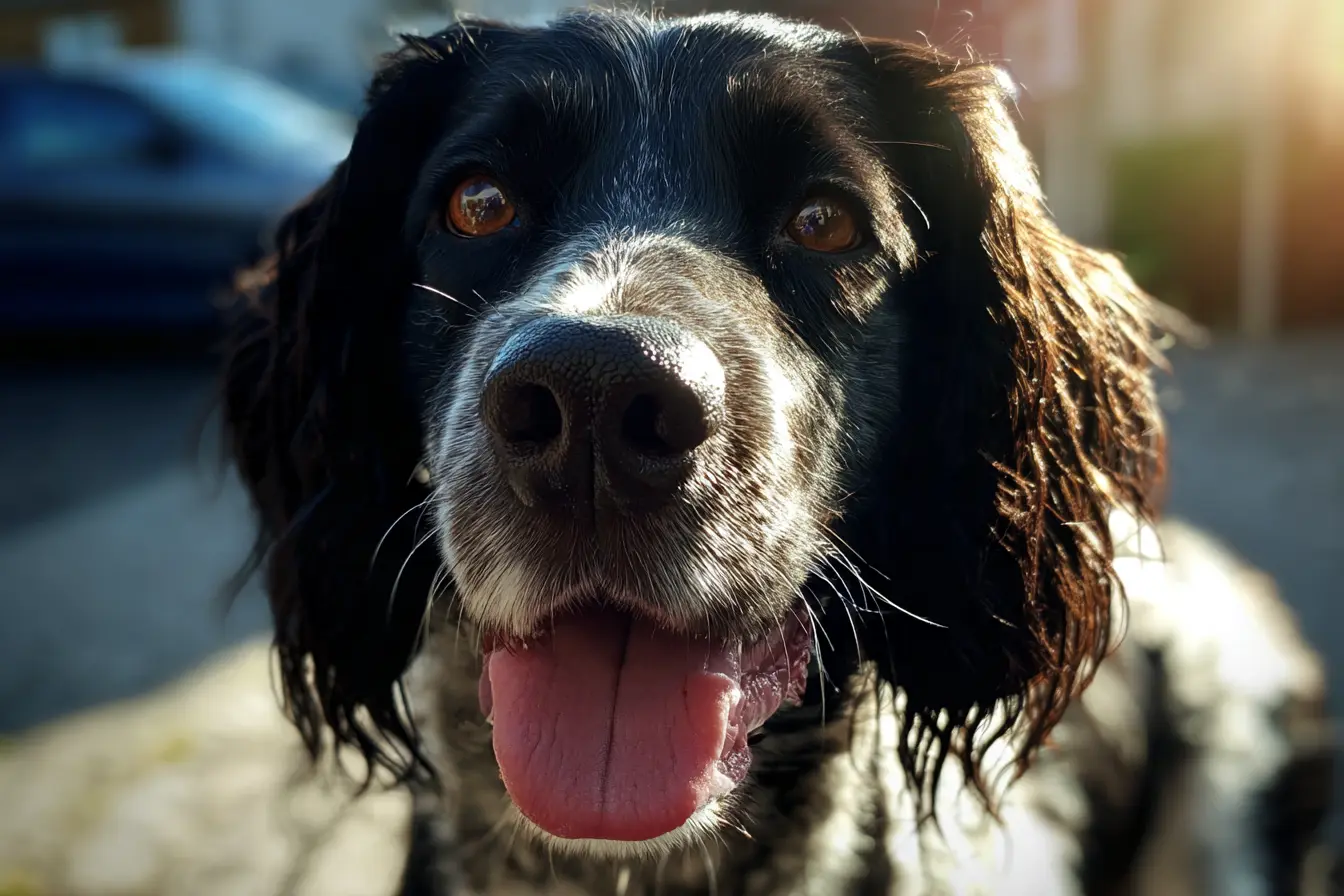
A Sprocker Spaniel is a cross between an English Springer Spaniel and an English Cocker Spaniel, and it usually has the energy, nose and enthusiasm of both gundog parents. It can be a lovely companion for an active household that has time for long daily walks, steady training and regular ear and coat care, but it’s a poor match if you want a dog that’s content with a stroll round the block.
Both parent breeds were bred to find, flush and retrieve game, so most Sprockers love using their nose, carrying things and being out with their people. That drive doesn’t disappear because a dog lives as a pet.
What a Sprocker Spaniel is
The Royal Kennel Club doesn’t recognise the Sprocker as a breed. There’s no breed standard, and a Sprocker can’t be registered as a pedigree. In practice that means you can’t predict exactly how big a puppy will grow, what its coat will be like or how driven it will be.
The parents give you the best clues. PDSA gives an average height of about 51cm and a weight of 18 to 23kg for the English Springer Spaniel, and 38 to 41cm and 13 to 14.5kg for the Cocker Spaniel. Most Sprockers end up somewhere in that range, some more Cocker-sized and some closer to a Springer.
Many Sprockers come from working gundog lines. PDSA notes that Cockers from parents bred to work will probably need more exercise than the average Cocker, and the same is likely to be true of their crosses. If either parent is a working dog, ask what that looks like day to day: how much exercise it gets, how it settles at home and how it behaves around birds and livestock.
There are no reliable lifespan figures for Sprockers themselves. A 2024 study led by Dogs Trust, using records for more than half a million UK dogs, gave median life expectancies of 13.3 years for English Cocker Spaniels and 13.5 years for English Springer Spaniels, which gives a rough idea for the cross.
Exercise, training and home life
Plan for a lot of exercise. PDSA advises more than two hours a day for English Springer Spaniels and at least an hour for Cocker Spaniels, with working-line Cockers likely to need more. A Sprocker from working parents will often sit at the Springer end of that range. Your dog’s age, health and fitness matter too.
How the dog exercises counts as much as how long. Off-lead running in safe places, sniffing, hunting for hidden toys and retrieve games all use the instincts the parent breeds were bred for. A bored spaniel tends to find its own jobs, which can mean chewing, barking or raiding the bins.
Recall needs real work. A Sprocker following a scent or a bird can switch off completely, so practise in quiet places first and use a long line on open ground until the dog comes back reliably. Keep it on a lead near livestock and ground-nesting birds. Gundog-style training classes, scent work and other reward-based activities suit many Sprockers well.
Puppies shouldn’t be taken on long, demanding outings while they’re still growing. Ask your vet if you’re unsure how much to do, or if your dog becomes stiff, lame or reluctant to go out.
Sprockers usually want to be with their people. PDSA says Cocker Spaniels are prone to separation anxiety and shouldn’t be left alone for more than four hours, and many Sprockers are just as keen on company. Teach a puppy that short spells alone are fine, and speak to your vet if your dog barks, howls or damages things when left. They can check for a health problem and point you towards suitable behaviour help.
With children and other pets, it depends on the dog. Supervise children with any dog, and teach them to leave it alone when it’s eating, sleeping or moving away. Take care with small pets, chickens and cats until you know how strong the urge to chase is.
Ears, eyes and coat care
Long, heavy ears are the Sprocker’s main maintenance job. A Royal Veterinary College VetCompass study found English Cocker Spaniels were almost 15 times more likely than other dogs to be diagnosed with ear discharge, which the researchers linked to their heavy, hanging ear flaps. PDSA also lists ear infections as a problem in Springers.
Look inside your dog’s ears every few days and after swimming. Contact your vet if you notice redness, discharge, a bad smell, head shaking, scratching, a head tilt or pain when the ear is touched. Spaniels are prone to picking up grass seeds in summer, and sudden, violent head shaking after a walk can mean a seed has gone down the ear canal. Ring your vet the same day. Don’t put drops or cleaners into a sore ear unless your vet has told you to, as some can do harm if the eardrum is damaged.
The same VetCompass study found English Cocker Spaniels had 7.6 times the risk of dry eye (keratoconjunctivitis sicca), where the eye doesn’t make enough tears. Sticky discharge, redness or squinting are reasons to see your vet promptly.
Coats vary from fairly short to long and feathered. The Royal Kennel Club recommends daily grooming for Cockers, while PDSA advises brushing Springers once or twice a week with clipping about every three months. Brush a Sprocker several times a week as a starting point, more if it has a full coat, and check the feathering on the ears, legs and belly for tangles, mud and seeds. Many owners have the hair on the ears, feet and between the pads trimmed to reduce mats and stop seeds getting caught.
Health tests to ask about
Being crossbred doesn’t protect a puppy from inherited disease. Many of the conditions spaniels are tested for are recessive, which means a puppy is only affected if it inherits a faulty copy of the gene from both parents. One condition, acral mutilation syndrome (AMS), is on The Royal Kennel Club’s test list for both Springers and Cockers. It’s an inherited nerve disorder in which young puppies lose feeling in their feet and may lick and bite them, causing serious injury. Because both parent breeds can carry it, both parents of a Sprocker litter should have been DNA tested for AMS.
The Royal Kennel Club lists these tests for the parent breeds:
- Both breeds: hip scoring under the BVA/RKC Hip Dysplasia Scheme, and eye examination with gonioscopy (a check of the eye’s drainage angle for glaucoma risk) under the BVA/RKC/ISDS Eye Scheme.
- English Springer Spaniel: elbow grading under the BVA/RKC Elbow Dysplasia Scheme, plus DNA tests for AMS, fucosidosis (a progressive nerve disease), phosphofructokinase (PFK) deficiency, progressive retinal atrophy (cord1 PRA) and dyserythropoietic anaemia and myopathy syndrome (DAMS).
- Cocker Spaniel: DNA tests for AMS, progressive retinal atrophy (prcd-PRA), familial nephropathy (FN, an inherited kidney disease that causes kidney failure in young dogs) and adult-onset neuropathy (AON).
The BVA Canine Health Schemes are open to crossbreeds and dogs that aren’t registered with The Royal Kennel Club, so there’s no reason a Sprocker’s parents can’t be hip scored and eye examined. Ask to see the actual certificates or lab results for both parents, not just a statement that they’re “health tested”. For DNA tests, a carrier parent is acceptable if the other parent is clear for the same condition. A seller who says testing isn’t needed because the litter is crossbred hasn’t understood how these diseases are inherited.
Choosing a puppy or rescue dog
See the puppies with their mother, where they’ve been raised, and meet the father too if you can. Be wary of anyone who won’t show you health paperwork, wants to meet somewhere other than their home or pushes you to pay quickly.
Questions worth asking:
- Are the parents from working or pet lines, and how much exercise do they get?
- Which hip, elbow, eye and DNA tests have both parents had, and can I see the results?
- Have there been any ear, eye, joint, nerve or kidney problems in the family?
- How have the puppies been handled, and what everyday sights and sounds have they met?
A good breeder will ask about your routine in return. An adult Sprocker from a rescue is worth considering too, because its size, coat and energy levels are already known.
Register with a vet soon after your dog comes home. The first check is a good time to talk about vaccinations, parasite control, feeding, exercise for a growing spaniel and an ear care routine.
Quick questions
- What should I know about sprocker spaniel?
- Thinking about a Sprocker Spaniel? This UK guide covers the Springer and Cocker cross’s exercise needs, ear and coat care, and the health tests both parents should have. Vet Verified can help you compare UK veterinary practices by location, species, services and opening hours before you call.
- When should I contact a vet about sprocker spaniel?
- Contact a veterinary practice if your pet seems unwell, symptoms are getting worse, you are unsure what to do, or the situation may be urgent. Vet Verified helps you compare practice details, but a vet should advise on your pet's current care.
- Can Vet Verified help me find dog vets?
- Yes. Use Vet Verified to compare dog vets across the UK, then check practice profiles and call directly to confirm current availability.
Find a vet
Find a veterinary practice
Compare UK veterinary practices related to this topic. Call the practice to confirm its current services and availability.
Search by species
- Dog vets Find UK veterinary practices that list care for dogs. Compare opening hours, services, facilities and verified profiles, then contact a practice directly.
- Cat vets Find UK veterinary practices that list care for cats. Compare opening hours, services, facilities and verified profiles, then contact a practice directly.
- Bird vets Find UK veterinary practices that list care for birds. Compare opening hours, services, facilities and verified profiles, then contact a practice directly.